Sector Update
Bangladesh’s healthcare sector is undergoing a structural transformation, supported by policy reform, rising service demand, private-sector expansion, and rapid digital integration. The country has seen expanded public and private healthcare infrastructure, alongside growing investment interest in hospitals, diagnostics, pharmaceuticals, medical devices, health-tech platforms, and specialized tertiary care.
Policy momentum has also strengthened. The formation of the Health Sector Reform Commission marked a major step in reform, with recommendations focused on primary healthcare, affordability, universal access, and stronger institutional accountability. At the same time, higher FY2024-25 health allocation reflects continued fiscal support for the sector.
The sector is also seeing stronger private-sector confidence. The Business Confidence Index 2024-25 for Healthcare & Social Assistance recorded a +18.6 BCI score, one of the strongest positive scores among tertiary sectors. This optimism is linked to growing demand for local healthcare, rising potential for public-private collaboration, and opportunities to reduce outbound medical spending.
Digital health is emerging as a major growth pillar, supported by telemedicine, electronic health records, and national digital health infrastructure. These tools are improving the scope for scalable healthcare access, particularly for underserved and rural populations.
The sector, however, continues to face affordability, quality, and accessibility challenges. High household healthcare burden, service quality gaps, workforce constraints, and regional disparities continue to shape market needs. These are creating demand for specialized care, preventive healthcare, diagnostics, insurance, digital health, and decentralized private hospital networks.
Key Factors Driving the Healthcare Industry
- Large Domestic Market: Bangladesh’s expanding middle-income population, rising income levels, and growing demand for quality healthcare are strengthening the commercial case for private hospitals, diagnostics, pharmaceuticals, and health-tech services.
- Increasing Healthcare Spending: The FY2024-25 health allocation of BDT 41,407 crore, equivalent to 5.20% of the national budget, signals continued public-sector commitment to healthcare expansion. This supports demand for infrastructure, medicine, equipment, training, and service delivery upgrades.
- Digital Health and Telemedicine: Digital adoption is enabling scalable access to healthcare. In 2024, telemedicine consultations reached 83,551, while the Shared Health Record (SHR) platform generated over 4.78 million Health IDs, creating opportunities for digital health platforms, e-prescriptions, remote diagnostics, and data-enabled patient management.
- Aging Population and NCD Burden: Bangladesh’s aging population and rising burden of non-communicable diseases (NCD) are increasing demand for recurring care, specialist consultations, cardiovascular treatment, oncology, diagnostics, and long-term disease management.
- Strategic Policy Reforms and UHC Commitment: Bangladesh has committed to advancing Universal Health Coverage through the UHC Roadmap 2026–2035, aiming to ensure quality health services for all without financial hardship, while strengthening primary health care, expanding financial protection, and reducing out-of-pocket health expenditure.
- Positive Private-Sector Sentiment: Private-sector sentiment toward healthcare remains positive, reflecting optimism around rising demand, investment potential, digital adoption, and stronger public-private collaboration.
- Pharma and Clinical Investment Momentum: Bangladesh Bank data shows that Chemicals & Pharmaceuticals attracted USD 123.79 million in net FDI in FY2024, while the Clinical segment attracted USD 4.55 million, indicating continued investor interest in health-related sectors.
Market Dynamics
Bangladesh’s healthcare market is shaped by a dual public-private structure. The public system remains essential, accessible, and affordable for lower-income and rural populations, operating through community clinics, primary care facilities, district hospitals, medical college hospitals, and specialized institutions. However, due to the wider market served, public hospitals often face high demand and bed-occupancy pressures, leading to long waiting times and constraints on service quality.
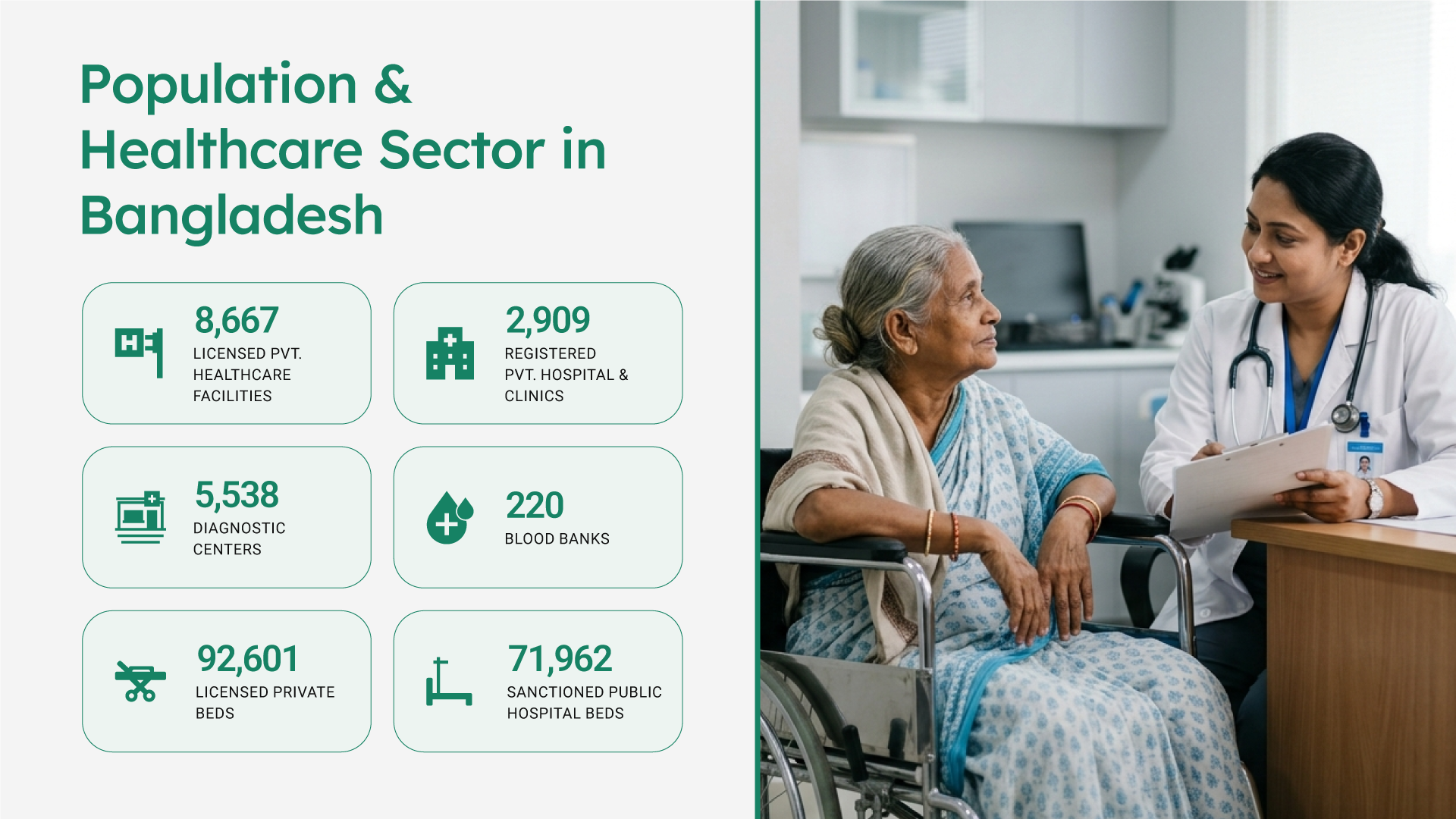
The private sector has expanded rapidly to meet demand from urban and higher-income patients. As of mid-2024, Bangladesh had 8,667 licensed private healthcare facilities, including 2,909 private hospitals and clinics, 5,538 diagnostic centers, and 220 blood banks, collectively offering 92,601 licensed beds. The government system also had 71,962 sanctioned hospital beds, indicating the scale of both public and private service-delivery capacity.
Bangladesh’s pharmaceutical sector is another significant layer of healthcare market dynamics. With 213 active companies, the industry meets approximately 98% of domestic medicinal demand and exports to over 150 countries, including regulated markets such as the USA, UK, and EU. In the first ten months of FY2024–25, pharmaceutical exports rose 3.46% YoY to USD 177.42 million, with the sector projected to surpass USD 6 billion in market size by 2025.
However, service concentration remains a key challenge as more than 50% of specialized hospitals and around 30% of private hospitals are concentrated in the capital city, Dhaka, limiting access for patients outside major cities and creating investment potential in secondary urban markets.
Medical tourism dynamics are also shifting. Political and access-related changes have limited traditional outbound treatment routes to countries such as India and Thailand, which previously served combined 77% of Bangladeshi outbound patients. This creates an opportunity for Bangladesh to retain patients locally by investing in specialized hospitals, diagnostics, oncology, fertility care, organ transplant services, and high-quality tertiary care.
Government Support & Policy Incentives
- 10-year corporate tax exemption for healthcare training institutes (e.g., nursing, pharmacy), applicable until 30 June 2030.
- 50% tax exemption on export income of medical devices applicable until 30 June 2028.
- Reduced import duties on raw materials for medical equipment.
- VAT exemption on locally manufactured medical beds and AT & SD exemption on imported and local raw materials & spare parts applicable until 30 June 2030.
- 100% tax holiday for producers of 5 specific Active Pharmaceutical Ingredient (API) molecules extended from 2022 to 2032.
- 7.5% tax holiday for producers of 3 specific API
) molecules extended from 2023 to 2032.
Challenges and Opportunities
Challenges:
- Import and API Dependency
Bangladesh remains heavily dependent on imported medical equipment and Active Pharmaceutical Ingredients, exposing the sector to exchange-rate volatility, supply chain disruptions, and rising production costs.
- High Out-of-Pocket Expenditure
Households continue to bear a large share of healthcare costs, with out-of-pocket (OOP) expenditure accounting for 68.5% to 73% of total health spending. This limits affordability and creates a strong need for health insurance, low-cost care models, and public-private financing mechanisms.
- Workforce Shortage and Maldistribution
Healthcare professionals remain unevenly distributed, with rural and primary-level facilities facing greater shortages. This limits service quality outside major urban centers.
- Infrastructure and Regional Disparities
Regional concentration of services remains a challenge, due to the centralized focus in major cities, mainly the capital, limiting access for patients in secondary cities and rural areas.
- Weak Regulatory Enforcement and Quality Gaps
Weak oversight, uneven clinical standards, and limited transparency continue to affect trust in both public and private healthcare services.
- Limited Private Investment
Private healthcare institutions often depend heavily on bank financing, which can restrict expansion, modernization, and long-term investment planning.
Opportunities:
- Curbing Healthcare Outflows
The shifting medical tourism landscape creates an opportunity for Bangladesh to retain patients locally by developing specialized tertiary healthcare centers in oncology, cardiology, fertility care, organ transplants, and advanced diagnostics.
- Decentralized Hospital Networks
Private hospital chains and diagnostic networks have strong potential in secondary cities and high-demand regional markets.
- Digital Health Scalability
Remote consultation, digital prescriptions, patient record platforms, AI-enabled diagnostics, and rural health-tech models can help expand access to underserved populations.
- Local Medical Device Manufacturing
The import-heavy medical device market creates opportunities for local production of consumables such as syringes, gloves, catheters, basic diagnostic tools, and low-risk equipment.
- Health Insurance and Managed Care
High OOP spending creates a strong opportunity for private insurers, hospitals, and digital platforms to develop affordable health insurance, subscription-based healthcare, and employer-backed health plans.
- High-Value Pharmaceuticals and Biopharmaceuticals
Bangladesh’s pharmaceutical sector has room to move toward biologics, biosimilars, vaccines, oncology drugs, and R&D-backed manufacturing, especially as LDC graduation increases pressure to strengthen competitiveness.