
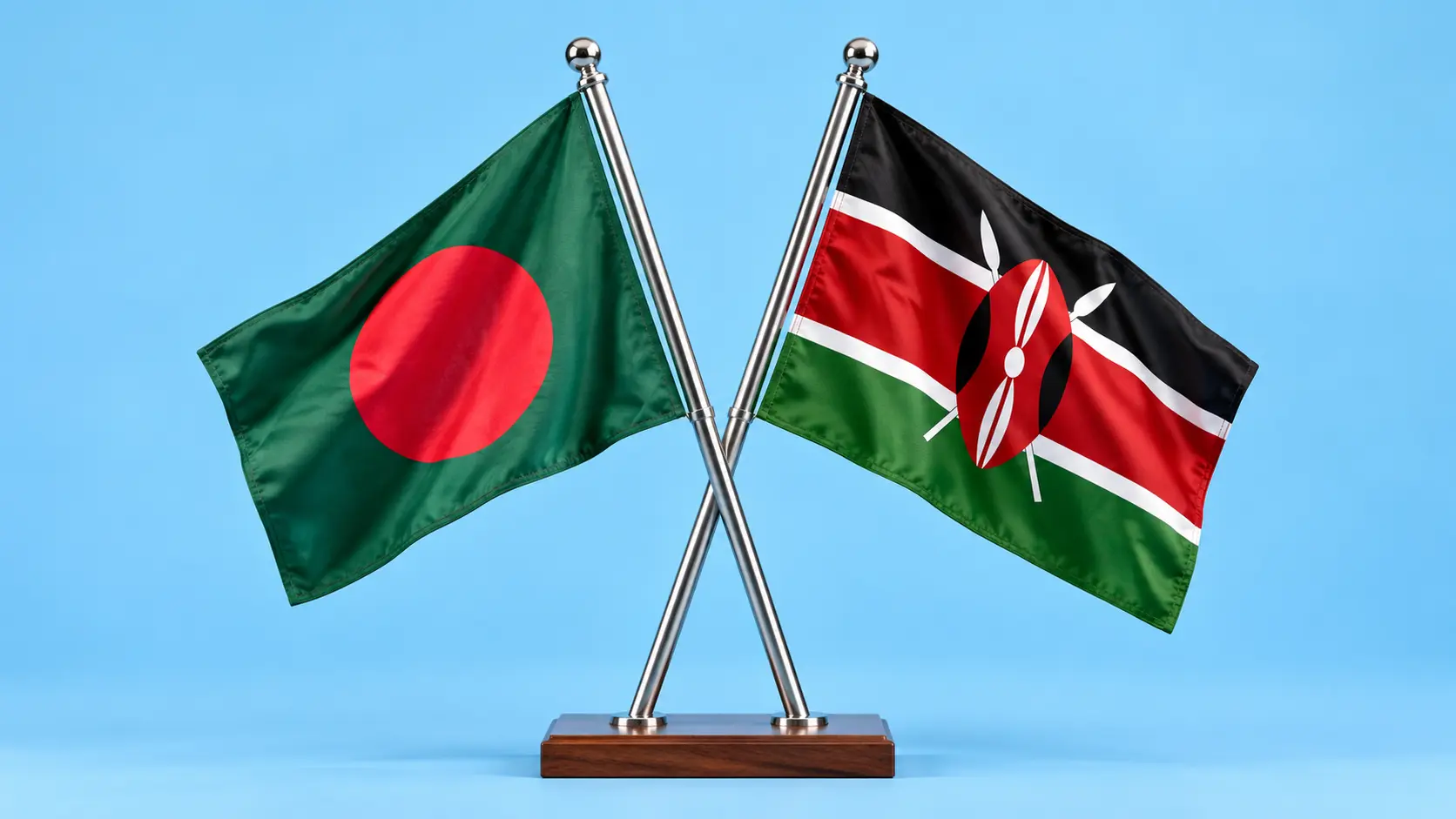
Bangladesh and Kenya have agreed to strengthen political, economic and sectoral cooperation following their third Foreign Office Consultations in Dhaka. Kenya also announced plans to establish a resident diplomatic mission in the Bangladeshi capital.
The two countries discussed cooperation across trade, investment, healthcare, agriculture, information technology, defence, climate change and the blue economy. They also explored opportunities to expand cultural and people-to-people ties.
Bangladesh and Kenya held the consultations on 14 October. Dr Nazrul Islam, Secretary (Bilateral) at Bangladesh’s Ministry of Foreign Affairs, led the Bangladeshi delegation. Ambassador Josphat Maikara, Director General for Political and Diplomatic Affairs at Kenya’s Ministry of Foreign and Diaspora Affairs, led the Kenyan side.
The two sides reviewed progress in bilateral relations since their previous consultations in Nairobi in July 2024.
During the meeting, Kenya informed Bangladesh of its plan to establish a resident diplomatic mission in Dhaka. The move could strengthen diplomatic engagement and support closer cooperation between the two countries.
Both countries also agreed to speed up several pending agreements and memorandums of understanding.
These include agreements on double taxation and investment protection. The two sides also aim to advance cooperation in the blue economy and contract farming.
Closer diplomatic ties could support further growth in trade and investment. They could also create new opportunities for businesses in both countries.
Bangladesh highlighted its capabilities in pharmaceuticals, ready-made garments, light engineering, jute products and agriculture.
Kenya expressed particular interest in sourcing more affordable and high-quality medicines from Bangladesh. It also encouraged Bangladeshi pharmaceutical companies to expand their investments in Kenya.
The discussions could create new opportunities for Bangladesh’s pharmaceutical sector to enter and expand within the Kenyan market.
Kenya, meanwhile, offered to increase exports of coffee, beans, cotton and processed meat to Bangladesh.
Greater trade in these sectors could help both countries diversify their commercial relationships. It could also open new supply channels for businesses and consumers.
Bangladesh and Kenya discussed several areas beyond traditional trade and investment.
These included agriculture, healthcare, information and communication technology, defence and climate change. The two countries also discussed cooperation in the blue economy.
Contract farming emerged as another area of potential collaboration. Greater cooperation could support agricultural production, knowledge exchange and stronger supply chains.
The discussions also covered culture, sports and people-to-people connections. These areas can support stronger long-term relations between the two countries.
Bangladesh and Kenya agreed to coordinate more closely at international forums.
The two countries plan to strengthen cooperation at the United Nations, the Commonwealth and the Indian Ocean Rim Association.
They also highlighted the importance of more high-level visits. Such exchanges could help maintain momentum in bilateral relations and turn ongoing discussions into concrete initiatives.
The two sides plan to hold the fourth round of Foreign Office Consultations in Nairobi in October 2028.
For Bangladesh and Kenya, stronger bilateral ties could support greater trade, investment and sectoral cooperation. The planned Kenyan mission in Dhaka could also provide a stronger institutional foundation for future engagement.
Source: The Business Standard
Contact us for a comprehensive understanding of the investment landscape in Bangladesh