Overview of the Sector
Bangladesh’s ICT sector has emerged as one of the country’s most promising growth engines, driven by strong government and increasing global demand for digital services. The sector spans software development, IT-enabled services (ITES), business process outsourcing (BPO), fintech, and digital platforms.
The domestic IT services market is estimated at approximately USD 2.1 billion in 2025, while the IT outsourcing market is valued at around USD 788 million, reflecting expanding enterprise digitalization and global outsourcing demand.
Bangladesh’s IT and ITES sector has demonstrated strong and sustained growth in recent years. Between 2025 and 2029, the market is expected to grow at a CAGR of 11.8%, reaching USD 3.29 billion, driven by increasing global demand for Bangladeshi digital services and strengthened confidence among industry stakeholders.
The country continues to build a dynamic digital ecosystem supported by a growing pool of skilled professionals and an expanding base of technology firms. Ongoing improvements in digital infrastructure, institutional support, and technology adoption are gradually strengthening the country’s capacity to compete in international markets.
Looking ahead, the global shift toward AI-enabled digital services, cloud operations, automation, and data-driven technologies presents a significant opportunity. Bangladesh stands to benefit directly: its large pool of English-proficient, competitive IT professionals, combined with government investment in Hi-Tech Parks and AI-skilling programs, positions the country to transition from commoditized ITES delivery to higher-value AI-augmented services. With continued investment in skills, innovation, and international market access, the country is expected to exceed USD 20 billion in IT/ITES exports by 2031 and play an increasingly important role in the global digital services economy.
Key Factors Driving the ICT & Startup Sector
- AI and Cloud as Growth Multipliers: Artificial intelligence has emerged as the dominant driver of global technology investment. In 2024, AI-related companies accounted for approximately 37 percent of total global venture capital funding and 17 percent of venture deals, reflecting strong investor demand for AI-enabled platforms, infrastructure, and enterprise solutions. Global AI startup funding reached USD 100.4 billion in 2024, driven by large investments in foundation models, AI infrastructure, and cloud-based platforms. For Bangladesh, the shift is twofold: while AI is automating lower-value IT tasks such as data entry and content labeling, it is also creating demand for higher-value services like AI model training, prompt engineering, quality assurance, and AI-driven development. With targeted upskilling, Bangladesh can reposition its cost-competitive talent base to capture a growing share of global AI services.
- Large Consumer Base: According to the Bangladesh Telecommunication Regulatory Commission (BTRC), the country had 196.08 million mobile subscriptions as of June 2024, reflecting continued expansion of mobile connectivity with over 4.59 percent growth from the previous year. Internet adoption has also grown significantly, with 142.70 million internet subscribers nationwide, including 129.17 million mobile internet users and 13.53 million fixed broadband (ISP and PSTN) subscribers. As a result, internet penetration has reached approximately 79.99 percent, creating a large digital user base that supports the growth of e-commerce, fintech, digital services, and technology startups across the country.
- Economic Growth and Stability: Bangladesh’s economic trajectory reflects a broader shift toward technology-enabled transformation, underscoring the rapid digitalization and smartification of everyday activities, where technology is increasingly required across a wide range of tasks, from classrooms to workplace operations.
- Diverse and Maturing Startup Ecosystem: Bangladesh currently hosts over 1,200 active startups operating across sectors, including fintech, e-commerce, edtech, healthtech, agritech, logistics, and climate technology. The country improved its ranking to 79th globally in the Global Startup Ecosystem Index 2025, indicating increasing ecosystem maturity and global visibility.
Investment Landscape
Bangladesh’s startup ecosystem continued to demonstrate active investment momentum in 2024, recording approximately USD 41 million in total startup funding across around 37–40 deals, reflecting sustained investor engagement in the country’s growing digital economy.
Investment activity in 2024 showed increasing maturity within the ecosystem, with late-stage funding reaching USD 29 million, highlighting investor preference for scalable startups with validated business models. Within this segment, Series A rounds alone raised USD 21 million, accounting for 73 percent of late-stage funding and about 51 percent of the total capital deployed.
Bangladesh also continued to attract strong global venture capital participation. International investors contributed approximately 98 percent of total startup funding in 2024, demonstrating sustained global interest in the country’s technology-driven businesses and scalable digital platforms.
Emerging sectors are also gaining traction. In H1 2024, climate and energy startups secured approximately USD 8 million in funding, accounting for 41 percent of total investments during the period, reflecting growing global interest in sustainability-focused ventures in Bangladesh.
Export Potential
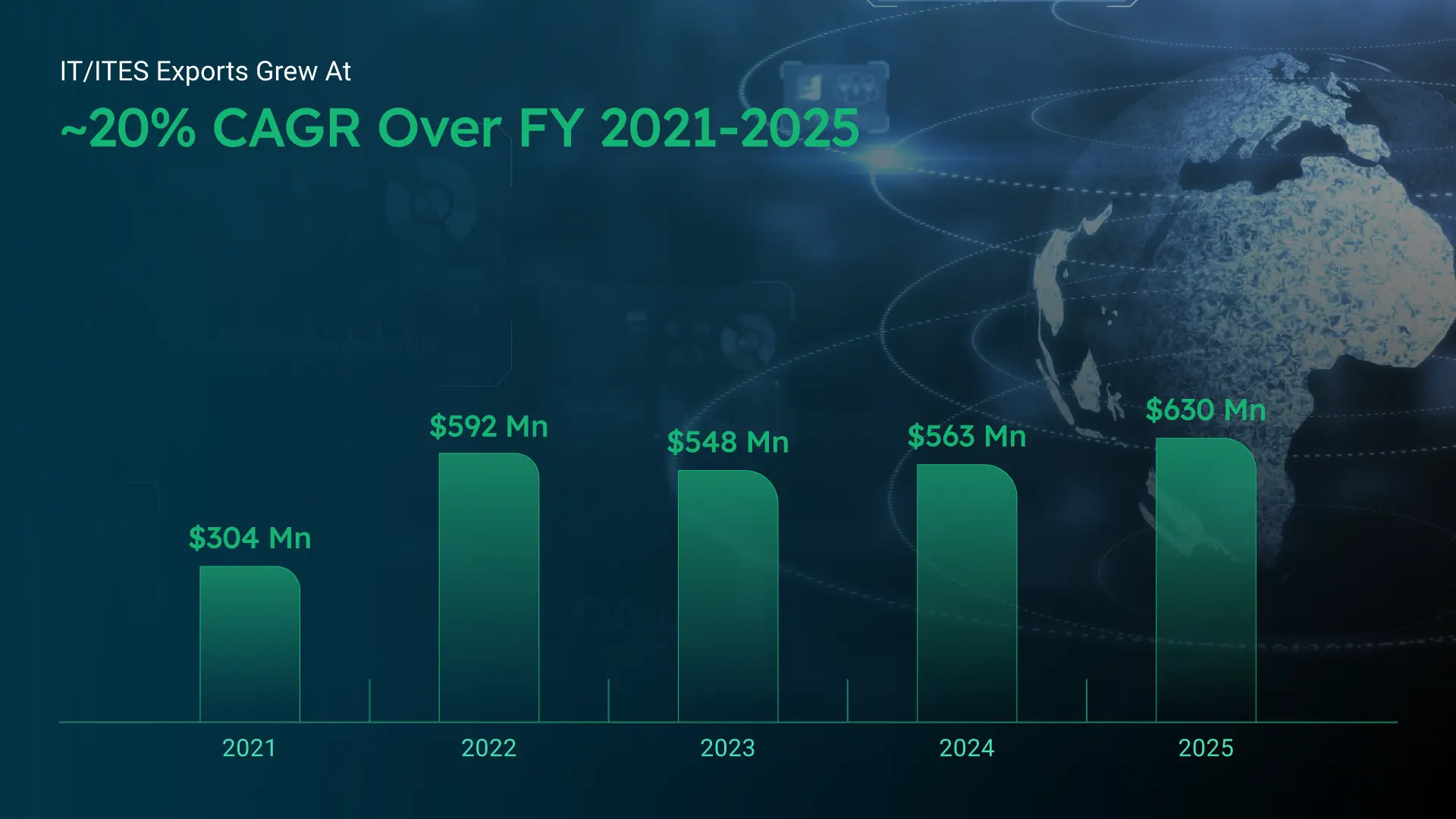
Bangladesh’s ICT and IT-enabled services (IT/ITES) sector continues to demonstrate strong export potential as global demand for digital services expands. The industry exports reached USD 630 Mn in FY 2025, growing at an estimated ~20% CAGR over the past four years. According to the Export Promotion Bureau (EPB) and Bangladesh Bank, ICT service exports reached USD 724.6 million in FY2024–25, representing 7.7 percent year-on-year growth, reflecting the sector’s steady integration into global digital service markets.
A significant share of these exports is driven by software and IT-enabled services. Approximately 87 percent of total ICT exports originate from computer services, including software development, IT outsourcing, and IT-enabled services. Telecommunications services account for around 13 percent, and information services contribute less than 1 percent. In FY2025 alone, computer services exports reached USD 629.5 million, highlighting the growing competitiveness of Bangladesh’s technology service providers in international markets.
Bangladesh currently hosts over 4,500 IT and software companies and more than 300,000 software professionals, enabling the country to deliver services across software development, outsourcing, and digital operations.
Cost competitiveness remains one of Bangladesh’s strongest advantages in attracting global clients. The operating costs for IT services in Dhaka are 16–20 percent lower than in Bangalore and nearly 30 percent lower than in Cebu, Philippines, including salary, benefits, facilities, telecommunications, technology infrastructure, and operational overheads. This cost advantage, combined with a growing talent pool, positions Bangladesh as an increasingly attractive destination for global outsourcing and technology service delivery.
Looking ahead, Bangladesh’s IT sector has considerable scope to expand its global footprint. With increasing demand for cloud services, data operations, cybersecurity, automation, and AI-enabled digital services, the country can leverage its competitive cost structure and expanding talent base to further scale exports.
Government Support & Policy Incentives
- 6 percent export subsidy for software, ITES, and hardware applicable until 31 December 2025.
- 0.3 percent to 2 percent export subsidy for product and market diversification for companies in high-tech parks applicable until 31 December 2025.
- All income generated from IT Enable (ITES) is tax-exempt, having income received through the banking channel applicable until 30 June 2027.
- 100 percent tax holiday for the first 7 years, 70 percent for 8 to 10 years for businesses established within the Hi-Tech park applicable until 30 June 2035.
- Exempted Corporate Income Tax (CIT) for the first 10 years for manufacturing motherboards, casing, UPS, speaker, sound system, power supply, USB cable, CCTV, pendrive having more than 30 percent value addition applicable until 30 June 2030.
- 5 percent VAT on locally produced and software customization services.
Future Trends and Opportunities
Challenges:
- Inadequate physical and digital infrastructure, including reliable power supply and high-speed internet, can impede the growth of tech startups and IT businesses.
- Although improving in terms of clarity and automation, obtaining necessary licenses and permits can be a cumbersome process, slowing down the pace of innovation.
- While Bangladesh has a pool of young and talented individuals, there is a shortage of skilled professionals in specialized areas such as software development, data science, and cybersecurity. Retaining top talent can also be challenging due to global competition.
- Ensuring the protection of intellectual property rights can be a challenge. Startups may face difficulties in safeguarding their innovations and ideas from unauthorized use or replication.
- Periodic political instability and economic uncertainties can create an unpredictable business environment, affecting the confidence of investors and startups.
Opportunities:
- Government-backed incentives continue to support export-oriented sectors, including IT/ITES, primarily through cash incentives on export earnings. As per Bangladesh Bank provisions, eligible exporters receive financial incentives (around 6 percent for IT/ITES exports), which help reduce operational costs and enhance competitiveness in international markets. However, broader fiscal benefits such as tax holidays or exemptions depend on specific regulatory frameworks and are not uniformly applicable across all firms.
- Operating costs in Dhaka are 16-20% lower than in Bangalore and 30% lower than in Cebu. Jessore, Rajshahi, and Kaliakor have even lower operational costs.
- Climate change concerns have taken center stage globally, making climate and sustainability startups increasingly attractive to both local and international investors, presenting significant investment potential.
- In the face of a global recession, there is a notable increase in new ventures initiated by Bangladeshi professionals returning from abroad. Additionally, the startup landscape in Bangladesh is witnessing the emergence of startups structured with international holding companies owning the majority stake, while a Bangladeshi entity serves as the operating company, indicating diversification in business models.