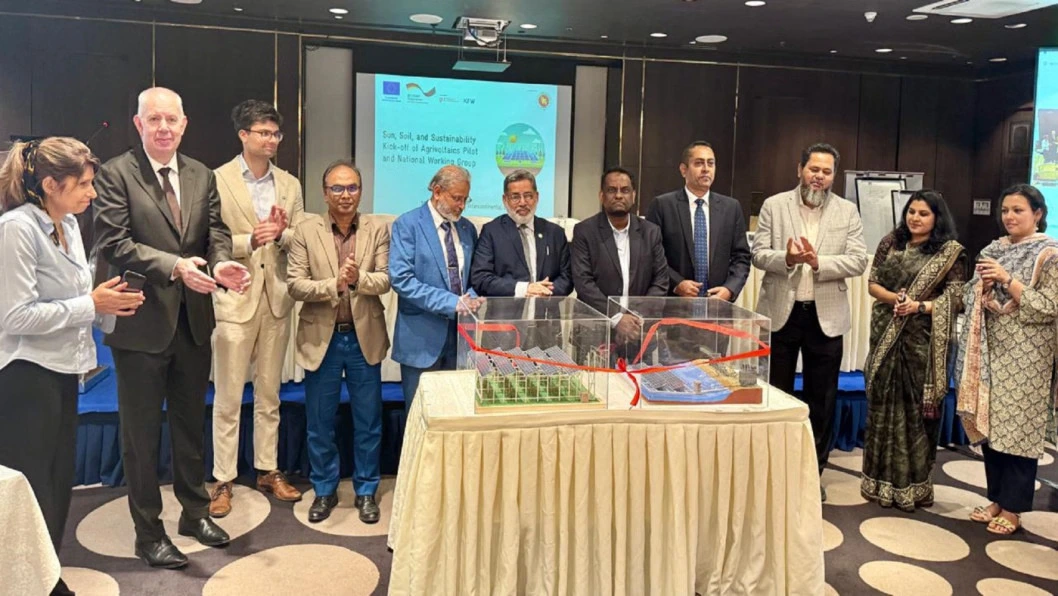
Bangladesh today launched its first structured Agrivoltaics Pilot Project and formed a national working group on Agrivoltaics and Floating Solar. The initiative marks a major move toward expanding renewable energy while using land more efficiently in a land-scarce country.
The pilot will evaluate the technical, agricultural, and economic feasibility of agrivoltaic systems in Bangladesh. Policymakers expect the findings to guide future scale-up efforts. The project supports the Renewable Energy Policy 2025, which targets 30 percent renewable energy in the power mix by 2040.
The Power Division of the Ministry of Power, Energy and Mineral Resources and the Green Energy Transition Policy Advisory Partnership (GET-PAP) jointly organised the launch event. GIZ Bangladesh implements GET-PAP. The European Union and the German Federal Ministry for Economic Cooperation and Development (BMZ) co-fund the project.
Speaking as chief guest, Nur Ahmed, additional secretary of the Power Division, said the project looks beyond a single installation.
“By using sunlight to grow crops and generate clean electricity, we address food security and accelerate the shift to renewable energy,” he said.
Edwin Koekkoek, team leader at the EU Delegation to Bangladesh, praised Bangladesh’s progress in climate adaptation. He said the country continues to share valuable technologies and expertise. He also noted the EU’s interest in strengthening cooperation on green energy transition.
During the technical sessions, experts from GIZ, Fraunhofer ISE, and IDCOL shared findings on system design, crop performance, and investment needs. Participants also reviewed regional experiences and lessons from the Indian Agrivoltaics Alliance to inform future expansion in Bangladesh.
Source: The Daily Star
Gain perspectives of the emerging sectors of Bangladesh
InsightsContact us for a comprehensive understanding of the investment landscape in Bangladesh