logo
Close

The World is Acknowledging

BANGLADESH

As an emerging economic force

5 Reasons Why

Bangladesh Is An Attractive Investment Destination

1. Resilient Economic Growth

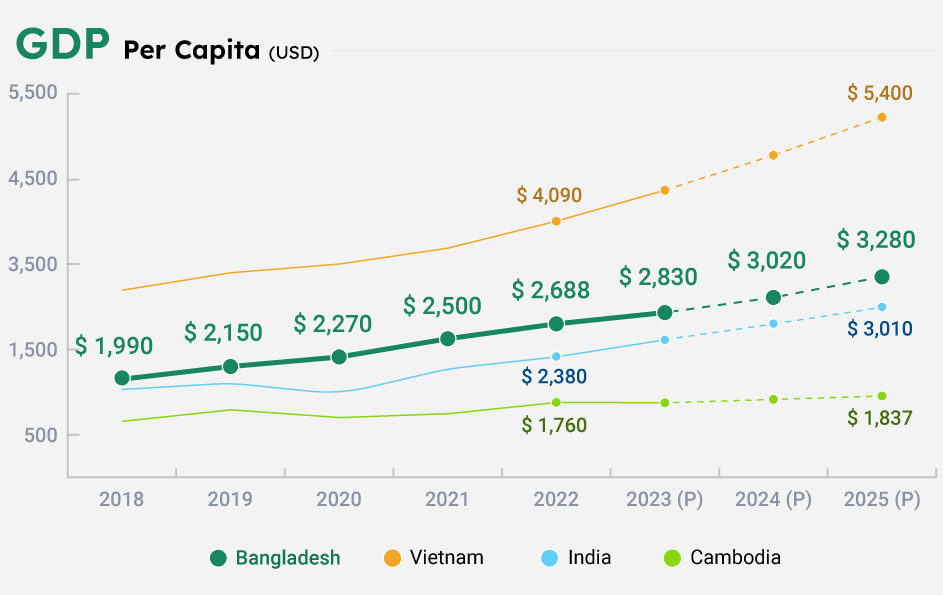
Bangladesh remains South Asia’s second-largest economy with a nominal GDP of approximately USD 475 billion in 2025. GDP per capita reached USD 2,734 in 2025, up from USD 2,619 in 2024, reflecting consistent income growth despite a period of political transition.
The International Monetary Fund notes that Bangladesh’s growth trajectory remains fundamentally resilient, with projections indicating a rebound to around 5% in FY2026 and FY2027 as macroeconomic reforms take effect and investment activity strengthens. Similarly, the World Bank and Asian Development Bank project FY2026 growth at 4.8% and 5.0%, respectively, underscoring confidence in the country’s medium-term outlook.
A landmark milestone approaches as the United Nations General Assembly has confirmed Bangladesh’s graduation from Least Developed Country (LDC) status on 24 November 2026, following the achievement of all three graduation criteria (GNI per capita, Human Assets Index, and Economic Vulnerability Index) across consecutive review cycles. Bangladesh is the first LDC to meet all three criteria simultaneously. Post-graduation, the country will benefit from a structured transition period through 2029, supporting a smooth shift toward a more competitive, investment-driven economy.

Sources: IMF, ADB, World Bank, UN, UNCTAD, Worldometers

2. Growing MAC Population

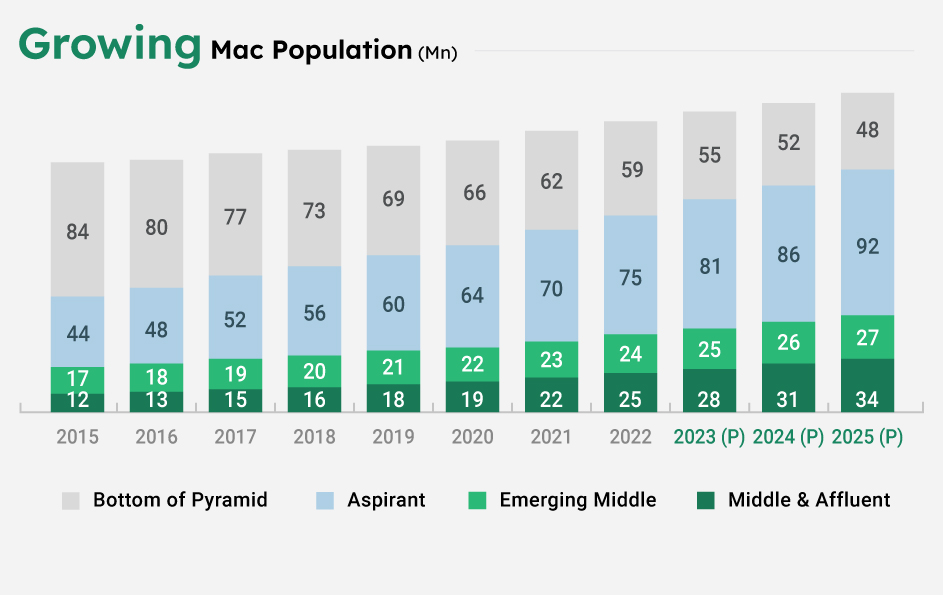
Bangladesh’s domestic consumer market represents one of Asia’s most compelling investment opportunities, combining scale with rapid expansion. Boston Consulting Group estimates the consuming class grew from 19 million in 2020 to 34 million by 2025 (~10.5% annually), supported by a population exceeding 175 million.
According to HSBC Global Research’s flagship “The Flying Dutchman: Asia’s Shoppers in 2030” report, Bangladesh is projected to become the world’s 9th-largest consumer market by 2030, overtaking the UK and Germany. HSBC ranks Bangladesh as the fastest-growing consumer market in Asia this decade, ahead of India, the Philippines, Vietnam, and Indonesia.
Private consumption accounts for approximately 71% of GDP (2025), reflecting strong domestic demand. Spending patterns are shifting toward higher-value sectors such as transport, housing, and financial services, indicating rising income sophistication. This momentum is reinforced by robust economic expansion, with Bangladesh expected to add around USD 43 billion in GDP annually between 2024 and 2029.
Strong demand fundamentals translate into attractive investor returns, with multinational firms in FMCG, telecom, and construction reporting ROE levels between 25% and 80%. Investor sentiment remains positive, with Bangladesh ranking 2nd in Asia and Oceania for business expansion interest in the 2024 Japan External Trade Organization survey.

Sources: Boston Consulting Group, HSBC Global Research, BIDA, World Bank,UNCTAD

3. Demographic Dividend

Bangladesh possesses one of the most favourable demographic profiles in South and Southeast Asia. According to the UN World Population Prospects 2024 Revision, the country’s 175 million people (2025 estimate, UN Population Division) have a median age of 26.3 years, significantly below the global median of ~30 years. The UNFPA confirms that two-thirds of the population is of working age, providing a sustained labour supply and a long consumption runway for investors.
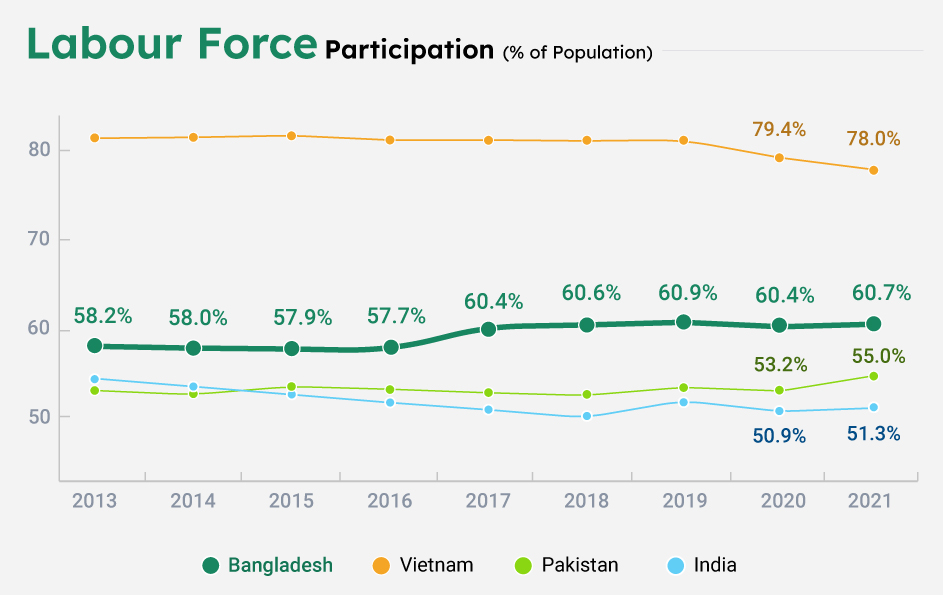
Critically, female labour force participation has risen to 39% in 2024, according to ILO modelled estimates published by the World Bank. This trajectory, driven primarily by the RMG sector’s 4 million workforce (of whom ~60% are women as of 2025), is directly linked to productivity gains, poverty reduction, and household income growth.
The working-age population bulge positions Bangladesh to capture a sustained demographic dividend over the next two to three decades, a period during which the dependency ratio is at its most favourable for economic expansion.

Sources: Worldometers, Bangladesh Sangbad Sangstha, UN DESA, World Bank, BGMEA, ILO

4. Strategic Location

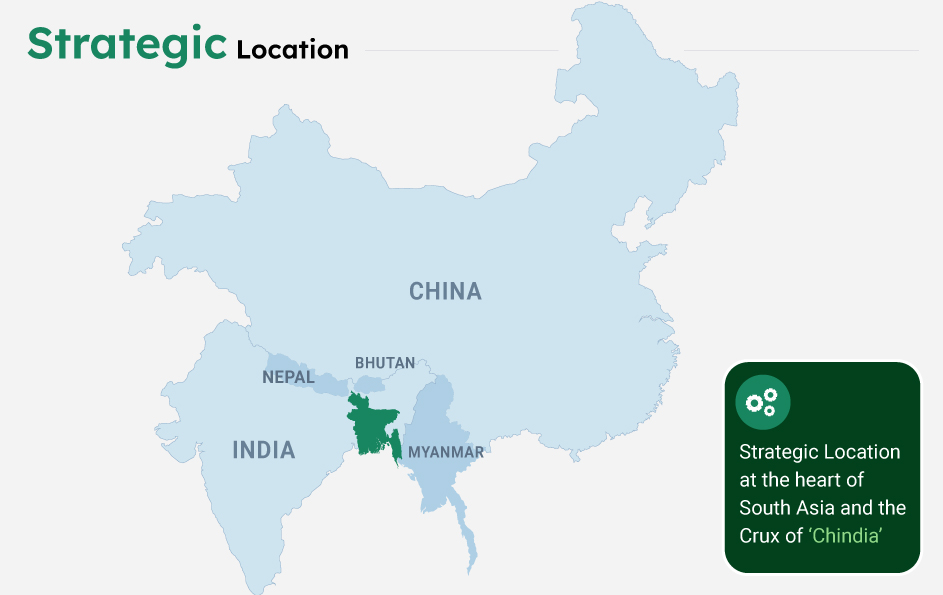
Strategically located between India and China, Bangladesh offers access to a combined regional market of over 2.8 billion people. Positioned along the Bay of Bengal and integrated into major connectivity corridors such as Belt and Road Initiative, the country is strengthening its role as a regional trade and logistics hub linking South and Southeast Asia.
Bangladesh provides preferential and evolving market access through key economic partnerships, particularly with the European Union, where ongoing engagement toward GSP+ aims to sustain competitive export advantages. Alignment with international standards, including ratification of core conventions by the International Labour Organization, reinforces Bangladesh’s position as a reliable and compliant sourcing destination within global value chains.
In manufacturing, Bangladesh is the world’s second-largest garment exporter, with RMG exports reaching USD 39.35 billion in 2024. The sector employs over 4 million workers and is supported by more than 240 LEED-certified green factories, the highest globally, positioning the country as a leading hub for sustainable and ESG-aligned production

Sources: BGMEA, ILO, UN DESA, UN, European Commission, GoB

5. Rapid Digitalization

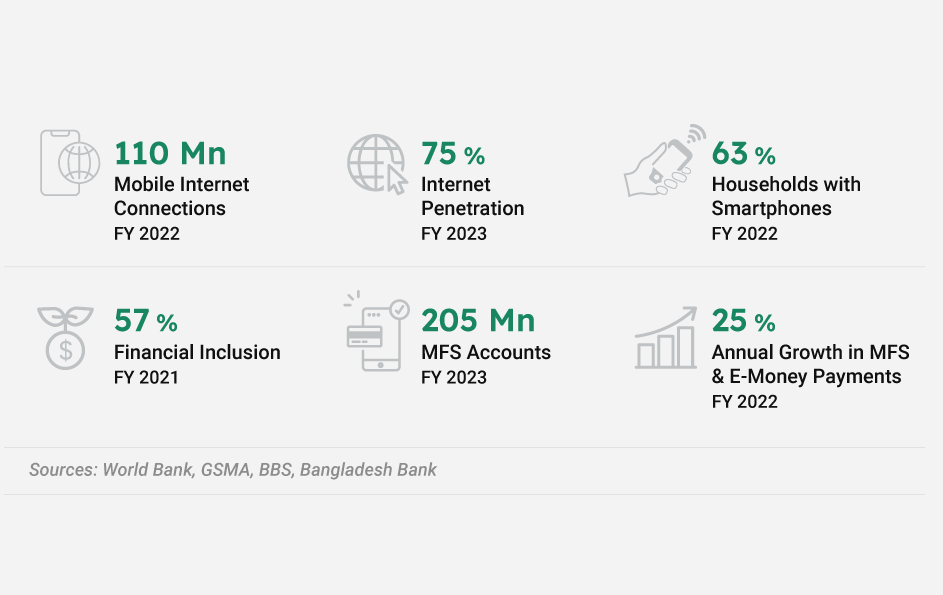
Bangladesh’s digital economy has grown substantially, underpinned by near-universal 4G infrastructure and a world-class mobile financial services ecosystem. As of January 2025, there are 77.7 million internet users, with an internet penetration rate of 44.5%.
Bangladesh’s Mobile Financial Services (MFS) industry has emerged as a globally recognized leader in digital financial inclusion. As of December 2024, the total number of registered MFS accounts stood at 237 million, according to Bangladesh Bank, with the female users accounting for 41.6%. Approximately 37.6% of these accounts are classified as active.
Bangladesh’s digital financial ecosystem continues to operate at significant scale, with 1.83 million agents and average monthly transactions of BDT 1,647.4 billion in 2024, providing a strong foundation for the next phase of financial innovation. Building on this base, the sector is now transitioning toward digital banking and nano-banking models, expanding access to formal financial services for individuals and SMEs.
Under the government’s ‘Smart Bangladesh’ agenda, infrastructure development is increasingly geared toward 5G readiness and advanced connectivity.This is accelerating digital consumption, with rapid growth in e-commerce and online platforms, positioning Bangladesh as a high-growth, tech-enabled market.

Sources: NGITAL, DataReportal, Transparency International Bangladesh, BTRC