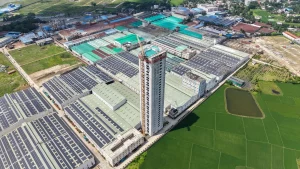
Once home to one of the world’s largest jute mills, the industrial land of Adamjee in Narayanganj has undergone a major transformation. Today, Adamjee Export Processing Zone (EPZ) is a major export and employment hub, generating more than $1 billion in annual exports and employing over 76,000 people.
Built on the former site of Adamjee Jute Mills, the EPZ has completed two decades of operation. It now hosts 47 production units that manufacture garments, bridal wear, safety footwear, automotive components and other specialised products for global markets.
According to the Bangladesh Export Processing Zones Authority (BEPZA), investment in Adamjee EPZ has reached around $847 million. Cumulative exports stand at $11.112 billion. Annual exports crossed $1 billion in FY25 and reached $1.179 billion in FY26.
This performance has also surpassed the original project target. The initial project proposal estimated annual exports of around $750 million once the EPZ became fully operational.
Md Abdur Rahman Bhuiyan, executive director of Adamjee EPZ, told The Business Standard that exports had crossed $1 billion for the second consecutive fiscal year.
“The project proposal had estimated annual exports of around $750 million once the EPZ became fully operational. But exports exceeded $1 billion in FY25. With the 10 factories currently under construction coming into production, annual exports can potentially reach $1.5 billion,” he said.
Investor interest also remains strong. However, all available plots have already been allocated. BEPZA is now exploring options to expand the zone further.
The 292-acre EPZ currently employs 76,027 people, according to BEPZA. With 10 more factories under construction, direct employment could exceed 100,000 once those facilities begin production.
The zone’s factories supply garments to global brands such as Tommy Hilfiger, Ralph Lauren, Michael Kors and Van Heusen. At the same time, Adamjee EPZ is expanding beyond traditional apparel.
Its production base now includes safety equipment, footwear and automotive components. This diversification is creating opportunities for more specialised and higher-value exports.
For example, Universal Menswear Ltd, a Romania-Bangladesh joint venture, has invested $45.91 million in the zone. The company employs 8,194 people, including 8,160 Bangladeshis and 34 foreign workers.
It produces tailored men’s suits, blazers and formal trousers. In FY26, the company exported products worth $97.88 million.
Super Protective Shoes (Pvt) Ltd is another example of this diversification. The Ukrainian-invested manufacturer has invested $13.06 million and employs nearly 1,000 people.
In FY26, it exported $12.77 million worth of safety shoes, industrial footwear, military boots and specialised footwear.
Lavryk Andrity, chairman and managing director of the company, said the factory is introducing specialised machinery to produce technically advanced footwear. Some machines come from Europe, while others are sourced from Taiwan and China.
Japanese company TS Tech Bangladesh Ltd has also established a presence in Adamjee EPZ. It has invested $4.67 million and employs 512 people, including 508 Bangladeshis and four Japanese workers.
The company exported $14.75 million in FY26. Its main product is automotive seat-trim covers for Japanese vehicle manufacturers.
TS Tech sources most of its materials from Japan and China. It then processes the covers in Bangladesh before sending them to production facilities in Japan.
Managing Director Satoru Onishi said the company is increasingly focusing on productivity and automation. This includes using 3D printing for internal production work.
Since beginning operations in January 2017, the company has gradually expanded its production capacity.
The zone’s diversification is also visible in its high-value apparel production.
UBF Bridal Ltd, a German-invested company, produces premium wedding and evening wear. Its products include dresses, suits, jackets, boleros, veils, petticoats and jewellery.
The company began operations in April 2022 with an investment of $3.66 million. It now employs 357 local workers and exported $5.27 million in FY26.
Khadeja Akter and Rani Akter are among the company’s sewing workers. Rani, who has worked there for nearly five years, said the favourable working environment and higher wages compared with factories outside the EPZ were key reasons for staying.
However, producing specialised bridal wear required new skills. Md Robiul Hoque Siddiki, chief operating officer of UBF Bridal, said Bangladesh initially lacked workers with experience in this type of production.
The company therefore trained its workers and managers internally.
UBF started with around 130 workers. Since then, worker efficiency has increased from about 30% to 60% as employees have gained experience.
The company manages design, manufacturing, embellishment and finishing in Bangladesh. Its products are exported to Germany and distributed across around 37 countries, including markets in Europe, the United States, Brazil and South Africa.
These products continue to carry the “Made in Bangladesh” identity. The company is also developing local embroidery and lace production and plans to manufacture footwear in Bangladesh.
The transformation of Adamjee EPZ becomes more significant when viewed against the history of the site.
Adamjee Jute Mills was established in 1950 in Siddhirganj by the Adamjee family. At its peak, it was one of the world’s largest jute mills.
The mill covered nearly 1,000 acres and developed into a large industrial community. Worker settlements, markets and schools grew around the factory.
After independence, the government nationalised the mill and placed it under the Bangladesh Jute Mills Corporation (BJMC). Over time, financial losses, management weaknesses, technological limitations and labour unrest pushed the mill into crisis.
The factory finally shut down on 30 June 2002, when around 20,000 to 25,000 workers were employed there.
The government then decided to repurpose the abandoned industrial land. On 30 December 2004, it approved the transfer of the land to BEPZA. Adamjee EPZ was formally inaugurated on 13 March 2006.
The early years were modest. In FY2005-06, the EPZ had only $4 million in investment and $0.23 million in exports.
Two decades later, the picture is very different. Modern factories now occupy the former industrial site, supporting more than 76,000 jobs across 47 operating production units.
Adamjee EPZ’s location between Dhaka and Chattogram has helped make it attractive to investors. Its connectivity, infrastructure and modern facilities have further strengthened its position as an export-oriented industrial hub.
The next phase of growth is already taking shape. Ten factories are currently under construction, and BEPZA expects them to push annual exports beyond $1.5 billion.
Employment could also rise above 100,000 once these factories begin production.
The zone’s impact extends beyond factories and export earnings. Its facilities also support workers and their families.
During a visit by The Business Standard, five-year-old Abdullah was leaving the EPZ with his mother, Shanta, at around 5:30pm. Shanta said the EPZ’s daycare centre allows her to work while keeping her son nearby. She described the facility as highly helpful.
Adamjee’s industrial landscape has therefore changed dramatically over the past two decades. A site once dominated by a struggling jute mill now houses modern factories producing high-value garments, specialised footwear and automotive components.
The transformation reflects a broader shift in Bangladesh’s industrial economy: from traditional manufacturing toward more diversified, specialised and globally connected production.
Contact us for a comprehensive understanding of the investment landscape in Bangladesh